
Access and information handling
Define who needs access to production and test systems, from where and for which tasks. Agree data-handling requirements and the security evidence your reviewers need.
Agree what is worth building, how your team will check it and who will support it. Your Australian project lead works with our engineers in Australia and Vietnam to make scope, cost, access and release decisions clear.
Scope to support
Compare what to retain, configure, connect or build. Agree the first release, its build and running costs, and who approves changes.
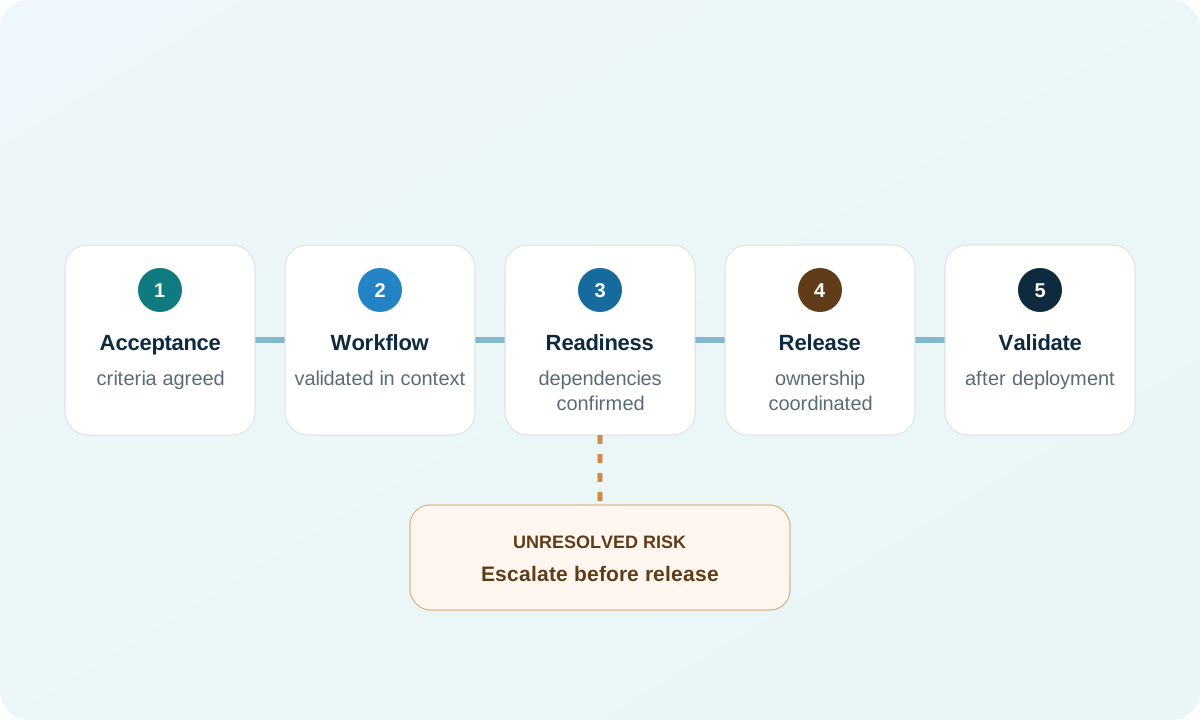
Twin demonstrates the work at agreed points. Your team can check it against the way people will use it.
Review the agreed workflows, user roles, data and connections against acceptance criteria. See what is ready and what remains unresolved.
Your team makes the go-live decision. Together we check dependencies, who is responsible and what to do if release has to pause.
Record support hours, issue and escalation routes, change responsibilities and the handover your team needs.
For an Australian example, see how ScriptStream progressed from conformance work into early production.
One operating model
Twin Global Solutions leads client engagement and coordination from the group’s Australian headquarters. Our engineering teams in Australia and Vietnam bring the product, software and data capability into the same programme. Your team contributes the business priorities, operating requirements and acceptance decisions.
We agree a team and review cadence suited to the programme. Demonstrations, access to the right people and clear decisions help the business and engineering work move together.
The client supplies the context and decisions that only the organisation can own.
The Australian team coordinates the client discussion, scope, priorities and commercial responsibilities.
Our engineers design, implement, test and support the agreed software.
Where a project needs additional expertise, a specialist may contribute to a clearly bounded workstream.
Security, acceptance and continuity
Make information handling, test evidence and recovery part of the delivery scope. Your reviewers can assess the arrangements for the system, with responsibilities and acceptance criteria agreed before release.
Define who needs access to production and test systems, from where and for which tasks. Agree data-handling requirements and the security evidence your reviewers need.
Engineering includes code review and testing. Review the agreed roles, records and integrations, including blocked actions, rejected exchanges and correction paths.
Confirm environments, migration, monitoring and open issues. Agree when to pause a release and the correction or rollback arrangements needed for the service.
Record the support hours, escalation route and operating responsibilities. The agreement defines source access, documentation and custom-code and reused-component rights.
For a documented example, see ScriptStream’s workflow, integration and conformance milestones. Its register entry covers the named prescribing product and version; the story records the wider delivery and production status.
Support and improvement after release
Support arrangements can cover release stabilisation, defect resolution, operational reviews, integration changes and planned improvements. The scope, hours, response arrangements and responsibilities are agreed for the engagement.
Your team sets the priorities from user feedback and operating needs. Twin assesses each change’s scope, dependencies and test requirements, then recommends a sequence for delivery.
Delivery in practice
Twin developed ScriptStream for BOP Plus, part of Wesley Pharmacy Group. In October 2026, the platform was in early production with real prescribers. Twin remained involved in onboarding, script imports, testing and further development; full PRODA integration was still underway.
View the ScriptStream storyProduct and delivery responsibilities
The proposal separates software access, configuration, connections, custom development and ongoing operation. Compare those costs and responsibilities for the approach your business needs.
| Approach | Software and product responsibility | What the engagement defines |
|---|---|---|
| Customised solutions | Applications, workflows, data platforms and integrations are developed against the agreed scope. | The agreement sets deliverables, custom-code and reused-component rights, source access, acceptance, environments and support. |
| Twin CRM and RIO | Twin owns the product suite. Configuration, extensions and connections are scoped around the organisation’s requirements. | Selected functions, software access, migration, integration, training, operating arrangements and agreed support. |
| PangoCDP | Byte Technology JSC (ByteTech) owns and develops PangoCDP. Twin Global is an authorised strategic partner and can lead the agreed advisory, solution-planning, integration and implementation-support work. | Product access, data and model configuration, customer journeys, channel connections, custom work and support responsibilities. |
The proposal identifies the relevant software, cloud, messaging and third-party costs, together with delivery and support scope. Product and project terms are recorded for the engagement.
Define the delivery model before work begins
Bring the business objective, people involved, existing systems and release priorities. We can then define the team, scope and practical next steps together.