PangoCDP customer story
TBS Retail: use customer response to make the next campaign more relevant.
In a reported 20-day programme, TBS Retail used purchase history to choose which store customers to invite online. Responses then helped the marketing team refine the next audience and avoid repeating invitations to people who had already joined.
About the client
International footwear brands, delivered through a national retail operation
TBS Retail is part of TBS Group and represents international footwear brands in Vietnam, including ECCO, Cole Haan and Rockport. Its published retail profile describes more than 41 stores nationwide, alongside its online shopping channels.
The customer platform gave this store-and-online operation a way to use purchasing context in digital campaigns: define the audience, recognise a response and decide who should receive the next message.
Client context: TBS Retail · published company profile. Company figures describe the client’s business; the project scope is set out below.
The customer need
Make an existing customer list useful for the next purchase.
TBS Retail needed to use an existing customer list selectively, then see who responded online. Purchase context and previous participation gave the team a basis for the next audience decision.
Project evidence
Retail expertise alongside the customer data platform
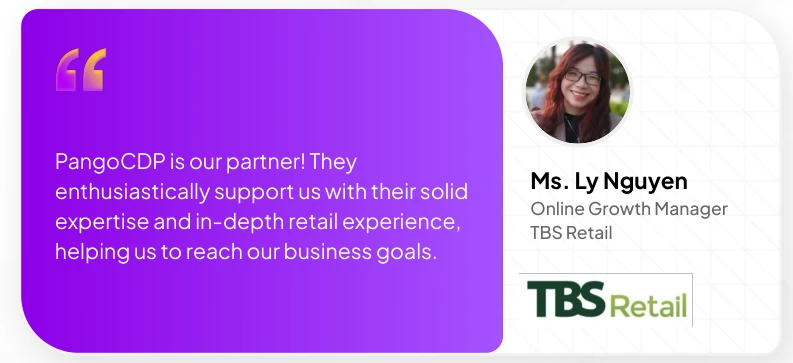
TBS Retail Online Growth Manager Ly Nguyen recognises the PangoCDP team’s retail knowledge and implementation support in the supplied customer presentation. The campaign work used that combination of data and retail practice to make each message more relevant to its audience.
The campaign approach
Let each response improve the next audience.
The published account describes customer groups based on location, age and purchasing information, including recency, brand and store preferences. After a campaign, the team could distinguish people who interacted from those who did not, then refine its follow-up.
For the next invitation, the team could exclude earlier participants and focus on customers who had not yet responded.
- Select a useful group
- Use customer and purchase information to define the audience.
- Respect earlier participation
- Exclude people who have already joined the preceding campaign.
- Adapt the follow-up
- Use response and purchase activity to guide later communication.
The campaign feedback loop
Summary of the programme journey described in the source material.
- SelectBuild an audience from the customer information.
- MessageSend the relevant campaign invitation.
- ReviewIdentify response and purchase activity.
- RefineAdjust the next audience and its exclusions.
Published campaign results
Reported campaign measures over 20 days.
PangoCDP reports the measures below for the 20-day campaign. The publication does not give a complete sales-growth baseline or every denominator, so the figures do not isolate incremental sales caused by the platform.
Figures reported by PangoCDP for this 20-day programme. The customer statement above describes the implementation support and retail expertise behind the audience work.
Discuss a similar programme
Give your next retail campaign a clearer customer purpose.
Twin can help assess your customer data, define useful audiences and connect messaging with the response you need to measure.